
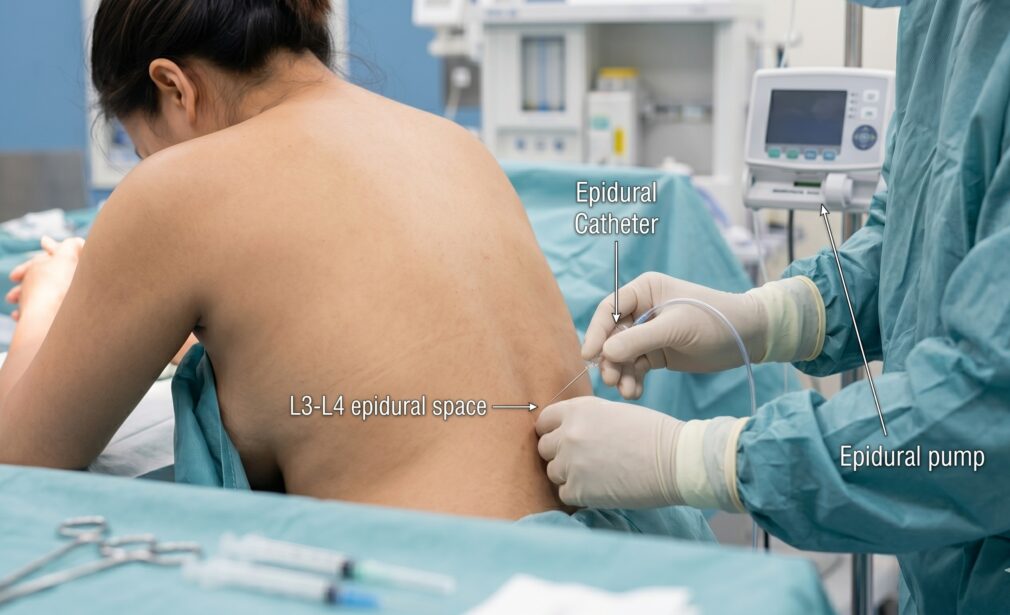
Painless Labour (Epidural Service)
The Epidural is the most effective and widely used method for providing regional anesthesia during childbirth. It allows a mother to be awake and active in her delivery while blocking the intense pain of contractions.
Step-by-Step Administration
Preparation: The mother sits or lies on her side, arching her back. The skin is cleaned and numbed with a local anesthetic.
Placement: An anesthesiologist inserts a specialized needle into the epidural space (just outside the membrane protecting the spinal cord).
Catheterization: A tiny, flexible tube (catheter) is threaded through the needle. The needle is removed, and the catheter is taped to the back.
Continuous Relief: Medication is delivered via an electronic pump, which the mother can often control (Patient-Controlled Epidural Analgesia or PCEA).
Benefits and Common Myths
Myth: “It slows down labor.” Fact: While it may slightly lengthen the pushing stage, it often speeds up the first stage of labor by allowing the mother to relax.
Benefit: It provides a “window of rest” during long, exhausting labors, preventing maternal burnout.
Safety: Modern “walking epidurals” use lower concentrations of medication, allowing for some leg movement while still blocking pain.