
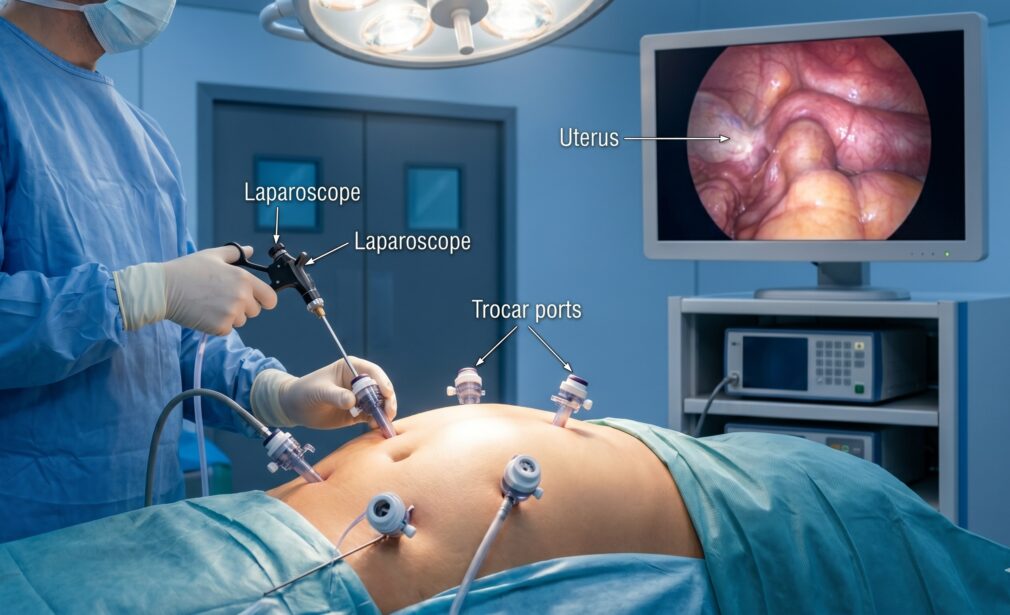
Laparoscopy (Minimally Invasive Surgery)
Laparoscopy is often described as the “gold standard” for modern gynecological surgery. It allows surgeons to perform complex procedures through tiny incisions, utilizing advanced optics and instrumentation.
The Technical Process
The procedure begins with the administration of general anesthesia. A small needle is used to fill the abdominal cavity with carbon dioxide (CO2). This process, called pneumoperitoneum, creates a “protective dome” of air, allowing the surgeon to see the organs clearly. A laparoscope (a thin telescope with a 4K camera) is inserted through the navel.
Depending on the complexity, two or three additional 5mm incisions are made near the hip bones for specialized tools like graspers, scissors, or laser devices. After the surgery is complete, the gas is released, and the tiny incisions are closed with dissolvable stitches or surgical glue.
Why it is Performed
Endometriosis Management: Identifying and removing painful endometrial tissue.
Ovarian Cystectomy: Removing cysts while preserving the healthy ovary.
Adhesiolysis: Breaking down internal scar tissue (adhesions) that cause chronic pain.
Ectopic Pregnancy: Safely removing a pregnancy that has developed outside the uterus.
Recovery Expectations
Most patients return home the same day. Common side effects include “shoulder tip pain”—a result of residual CO2 gas irritating the diaphragm—which usually resolves within 48 hours. Full physical recovery typically takes 1 to 2 weeks, compared to 6 weeks for open surgery.